
Tuesday, May 10, 2022

Tuesday, May 3, 2022

Monday, May 2, 2022
Married mothers take on more housework even when they out-earn their husbands
Source: https://tinyurl.com/2e5z89fh
Written by: EMMA HINCHLIFFE AND

Good morning, Broadsheet readers! President Biden chooses a nominee to serve as ambassador to Ukraine, Elon Musk’s purchase of Twitter could affect the future of content moderation on the platform, and becoming a breadwinner comes with a caveat. Have a great Tuesday.
– Double duty. Changing gender norms around parenthood and work have allowed women to become breadwinners for their families. But some gender norms are particularly stubborn, as Joanna Syrda, a professor at the U.K.-based University of Bath School of Management recently discovered.
In her research, analyzing the relationship between spousal income and the division of housework between partners, Syrda examined more than 6,000 North American dual-earner, mixed-gender couples between 1999 and 2017. She found that as the gender pay gap closes between a husband and wife, the gender housework gap rises—with the woman taking on even more housework as she begins to outearn her husband. The surprising inverse correlation reflects deeply held beliefs about who should be a breadwinner and who should take care of the home, Syrda argues.
See the statistical analysis below from her study “Gendered Housework: Spousal Relative Income, Parenthood and Traditional Gender Identity Norms” published in the journal Work, Employment, and Society. The chart shows a mother’s housework decreasing from 18 to 14 hours a week as she goes from earning no income to about half the household income—and then ticking back up again to almost 16 hours as she exceeds her partner’s salary. The husband’s housework starts around six hours a week when he’s a father and the sole breadwinner, reaching a maximum of just under eight hours before declining as his wife takes on additional housework with her rising income.
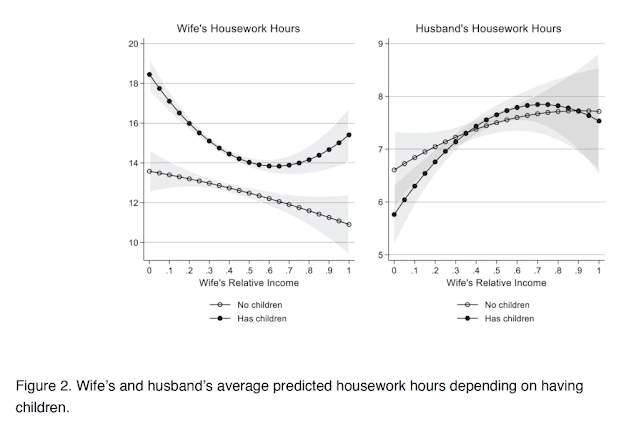
It might sound counterintuitive that women breadwinners spend more time on household chores when they earn significantly more than their husbands—and worse still, the data doesn’t even account for gender gaps between time spent by mothers and fathers on childcare. Syrda speculates that heterosexual couples are, perhaps subconsciously, compensating for deviating from the male breadwinner norm. (Past research has shown that men are more likely to exhibit signs of “psychological distress” when their wife earns more money.)
“This is a non-traditional outcome in that she is earning more money than him,” Syrda says. “So to compensate for that, they [follow the norm] traditionally for housework.”
Syrda’s analysis brings to mind a 2019 study I covered for Fortune. Researchers found that married women did more housework than single moms—despite theoretically having a partner at home to share the load. They also found that “marriage remains a gendered institution that ratchets up the demand for housework and childcare through essentialist beliefs that women are naturally focused on home and hearth.”
The question, as Syrda frames it today, is what housework means to us. “Is housework just a sequence of tasks we perform?” she asks. “Or is it a way of constituting and enacting a gender?”
The combination of parenthood and marriage seems to be the defining element here: Syrda didn’t measure the same uptick in household chores for high-earning women who are not mothers. Similarly, the 2019 study focused on motherhood, measuring the difference in household chores for married and single mothers. Parenthood can have a “traditionalizing effect,” Syrda argues, causing even the most progressive of women to adjust their adherence to gender norms as they feel internal and external pressure to excel at motherhood.
By one measure, Syrda’s study could denote progress; there are enough women breadwinners in the dataset to come to these statistically significant conclusions. But it’s hard to celebrate women as their household’s primary financial provider when doing so comes with a performative obligation to do the dishes.
Emma Hinchliffe
emma.hinchliffe@fortune.com
@_emmahinchliffe
Tuesday, April 19, 2022
What is sustainable finance and how it is changing the world
Source: https://tinyurl.com/2p9xy333
Written by: Douglas BroomSenior Writer, Formative Content

Sustainable finance offers higher returns for investors.
Image: UNSPLASH/Towfiqu Barbhuiya
- Investors no longer face a choice between profit and saving the planet.
- Sustainable finance is prioritizing businesses that help the environment.
- But it also focuses on inclusion and ethical business standards.
The drive to sustainability is transforming the way we live. But what is the impact on the way our savings and pensions are invested? Welcome to the world of sustainable finance.
Environmental, social and governance (ESG) considerations have come to dominate many investment decisions in recent years. Put simply, this means investing your money where it will make the world a better place.
What is sustainable finance
Sustainable investing covers a range of activities, from putting cash into green energy projects to investing in companies that demonstrate social values such as social inclusion or good governance by having, for example, more women on their boards.
Sustainable finance has a key role to play in the world’s transition to net zero by channelling private money into carbon-neutral projects, says the European Union, whose Green Deal Investment Plan aims to raise $1.14 trillion to help pay the cost of making Europe net zero climate change emissions by 2050.
To ensure that sustainable investments deliver on their promises, global accounting body the International Financial Reporting Standards Foundation has just set up the International Sustainability Standards Board to come up with new rules to validate sustainability claims.
Sustainable finance provides better returns
As well as helping the planet and making society fairer and more inclusive, evidence is mounting that sustainable businesses actually offer higher returns for investors.
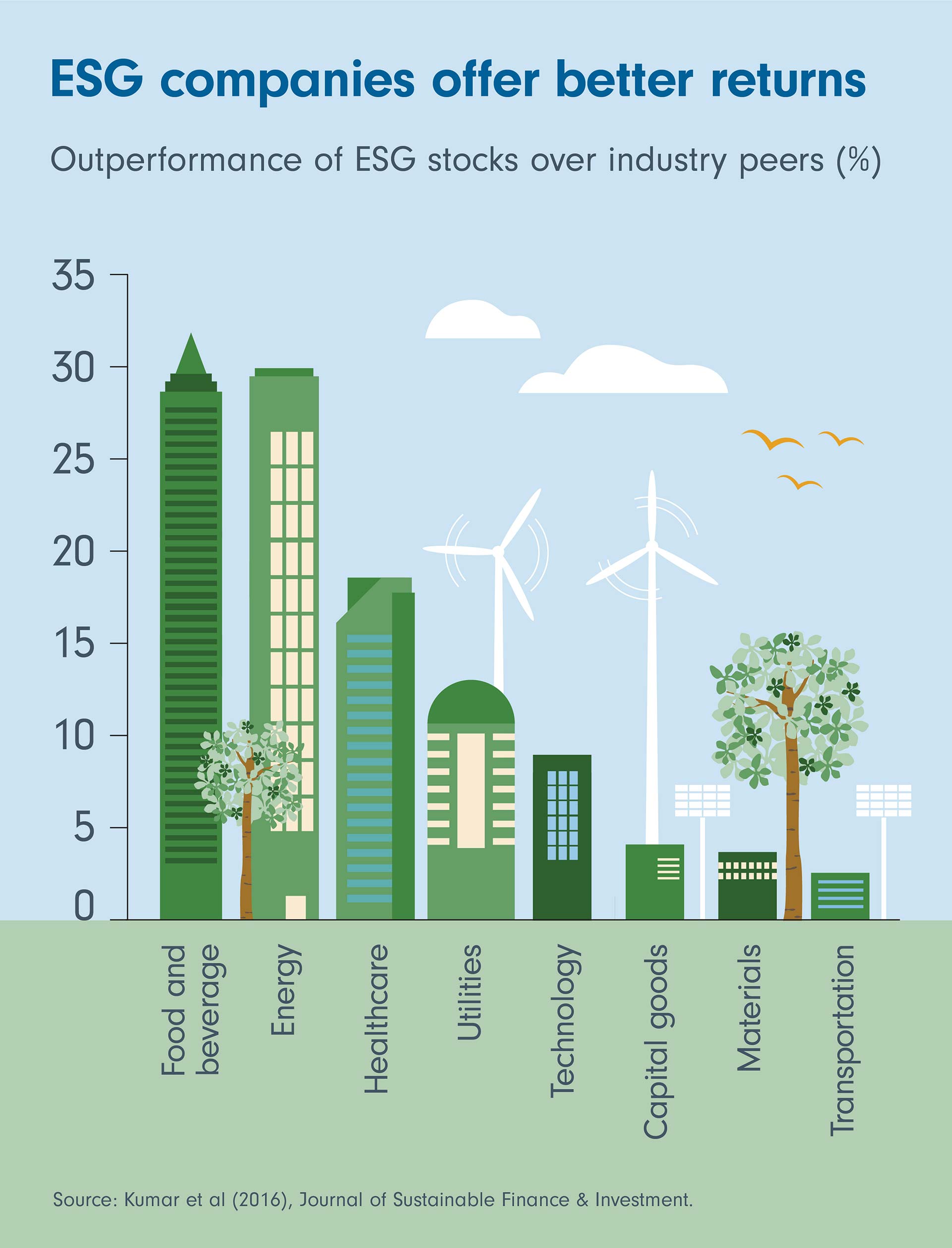
Image: Fidelity
A study conducted for asset manager Fidelity tracked the performance of a range of ESG investments worldwide between 1970 and 2014 and found that half of them outperformed the market. Only 11% showed negative performance.
Analysis by BlackRock – the world’s biggest asset management company – found that during the height of the COVID-19 pandemic in 2020, more than eight out of 10 sustainable investment funds performed better than share portfolios not based on ESG criteria.

Image: BlackRock
As well as paying higher dividends to shareholders, companies with high ESG ratings have also enjoyed stronger increases in their share price in the past five years, according to research by financial website Morningstar.
This matters because most stock market investments are made by financial institutions such as pension funds. In the United States, 80% of listed equity in leading companies is held by organizations that are looking after other people’s money.
While individuals may choose to earn a lower rate of return to save the planet, institutional investors and pension fund trustees don’t have that luxury. They must abide by what is known as a fiduciary duty to act in the best financial interest of investors.
But rising returns on sustainable assets mean trustees no longer have to sacrifice sustainability for profit. The World Economic Forum’s Transformational Investment report cites the example of New Zealand’s state pension fund, the trustees of which argued that climate change posed a risk to their ability to fund pensions and switched to a sustainable finance strategy. The fund has outperformed comparable investments by 1.24% a year since its inception in 2003 – a total difference of $7.24 billion (NZD10.65 billion).
But why do ESG-friendly investments do better than conventional investments?
Outperformance explained
One factor is changing customer attitudes. A study in the US found that two-thirds of consumers of all ages prefer to buy from companies that share their values. Among millennials – people aged between 18 and 34 – that figure rises to 83%.
Consumers are four to six times more likely to buy from a brand with a corporate purpose they endorse, according to a global survey. But if a company does something they disagree with, three-quarters said they stopped buying from that brand and encouraged others to do the same.
Carbon-intensive industries such as coal, oil and gas are also finding it harder and more expensive to raise capital as leading lenders refuse to do business with them.
In contrast, sustainable companies are more likely to win contracts, save costs by using fewer resources, have less regulation, retain the best people and avoid losing money on old carbon-intensive processes, according to research by McKinsey.
Global companies took in a record $859 billion in sustainable investments in 2021, Reuters reported, including $481.8 billion in green bonds that raised money for specific environmental projects.
And the level of sustainable finance is only set to grow. The total value of ESG investments is on track to exceed $53 trillion by 2025, accounting for more than a third of all global investments, according to analysis by Bloomberg.
Wednesday, April 13, 2022
Tuesday, April 12, 2022
STC Financial Management & Business Consulting. 6th Anniversary
STC 6th Anniversary!
As we celebrate our 6th anniversary, we want to THANK our favorite clients and friends for your support and business. We truly enjoy working with you and feel honored to be your chosen Financial Management & Business Consulting firm. Your business is much appreciated, and we will do our very best to continue to meet and exceed your Financial needs. WE ARE HERE FOR YOU!
If you know someone who needs the expertise we provide, we'd love to meet them. Thank you for being part of our journey.
#SoledadTannerConsulting,#profitandproductivity,#worksmarternotharder #improveprofit, #productivity,#CEO,#speaker,#Entrepreneur, #businessgrowth,#finance,#financialfreedom,#financialmanagement,#returnoninvestment,#productivitytips, #budget,#forecasts, #womeninBIZ,#womanownedbusiness,#leadership, #empowerment #excellence, #integrity,#flexibility,#experience, #efficiency #anniversary
Friday, April 1, 2022
The 3 Things Employees Really Want: Career, Community, Cause
Source: https://tinyurl.com/2p8457h8

Strike up a conversation about work values, and it won’t be long before someone brings up a pyramid — a famous psychologist’s best-known theory. Abraham Maslow’s big idea was that we all have a hierarchy of needs: once our basic physiological and safety needs are fulfilled, we seek love and belongingness, then self-esteem and prestige, and finally self-actualization. But that pyramid was built more than half a century ago, and psychologists have recently concluded that it’s in need of renovation.
When you review the evidence from the past few decades of social science, it’s hard to argue with Maslow’s starting point. If your basic needs aren’t met, it’s hard to focus on anything else. If you have a job that doesn’t pay enough, and you’re up all night worrying about survival, chances are you won’t spend much time dwelling on self-actualization.
But Maslow built his pyramid at the dawn of the human relations movement, when so many workplaces in the manufacturing economy didn’t have basic physiological and safety needs covered. Today more companies are operating in knowledge and service economies. They’re not just fulfilling basic needs; they’re aiming to fulfill every need, providing conveniences like meals and gyms, and competing to be the best places to work (from 1984 through 2011, those that won outperformed their peers on stock returns by 2.3% to 3.8% per year). In those environments, survival isn’t in question.
And once you get past that layer of the pyramid, the rest of it falls apart. People don’t need to be loved before they strive for prestige and achievement. And they don’t wait for those needs to be fulfilled before pursuing personal growth and self-expression.
If Maslow were designing his pyramid from scratch today to explain what motivates people at work, beyond the basics, what would it look like? That’s a question we set out to answer at Facebook, in collaboration with our people analytics team.
We survey our workforce twice a year, asking what employees value most. After examining hundreds of thousands of answers over and over again, we identified three big buckets of motivators: career, community, and cause.
Career is about work: having a job that provides autonomy, allows you to use your strengths, and promotes your learning and development. It’s at the heart of intrinsic motivation.
Community is about people: feeling respected, cared about, and recognized by others. It drives our sense of connection and belongingness.
Cause is about purpose: feeling that you make a meaningful impact, identifying with the organization’s mission, and believing that it does some good in the world. It’s a source of pride.
These three buckets make up what’s called the psychological contract — the unwritten expectations and obligations between employees and employers. When that contract is fulfilled, people bring their whole selves to work. But when it’s breached, people become less satisfied and committed. They contribute less. They perform worse.
In the past, organizations built entire cultures around just one aspect of the psychological contract. You could recruit, motivate, and retain people by promising a great career or a close-knit community or a meaningful cause. But we’ve found that many people want more. In our most recent survey, more than a quarter of Facebook employees rated all three buckets as important. They wanted a career and a community and a cause. And 90% of our people had a tie in importance between at least two of the three buckets.
Wondering whether certain motivators would jump out for particular people or places, we broke the data down by categories. We started with age.
There’s a lot of talk about how different Millennials are from everyone else, but we found that priorities were strikingly similar across age groups.

Contrary to the belief that Millennials are more concerned with meaning and purpose, we found that younger people cared slightly less about cause — and slightly more about career — than older people. In fact, people ages 55 and above are the only group at Facebook who care significantly more about cause than about career and community. This tracks with evidence that around mid-life, people become more concerned about contributing to society and less focused on individual career enhancement.
But overall, the differences between age groups were tiny. And that’s not just true at Facebook. In a nationally representative study of Americans across generations, Millennials, Baby Boomers, and Gen Xers had the same core work values — and tended to rank them in the same order of importance. As we’ve said before, Millennials want essentially the same things as the rest of us.
We also didn’t see any major differences by level, or by performance reviews: people valued these three motivators whether they were exceeding, meeting, or falling short of expectations. And when we compared office locations, it was clear that career, community, and cause were all prized around the globe.


Subscribe to:
Posts (Atom)